
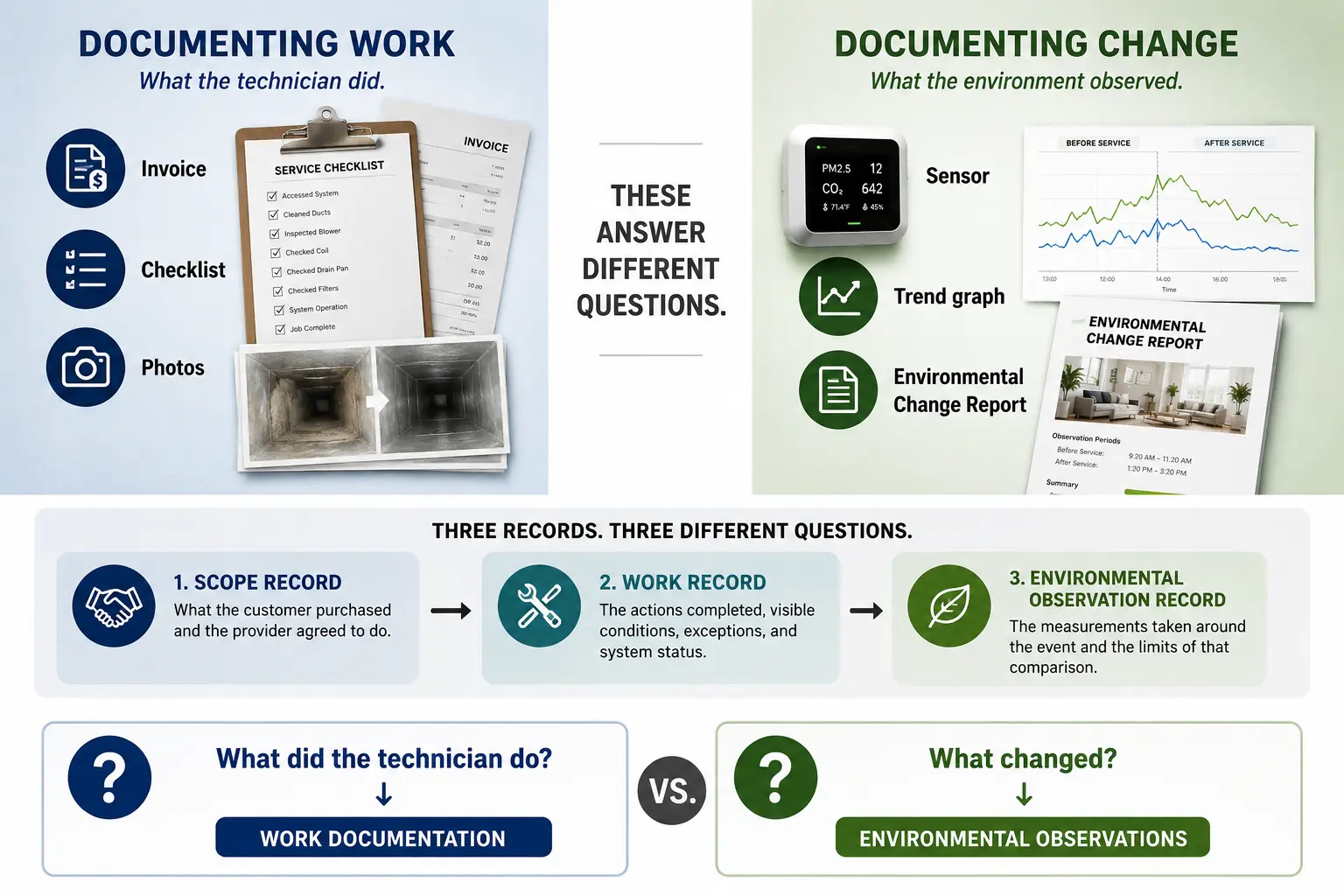
A technician finishes a job. The customer gets an invoice, a checklist, maybe a set of before-and-after photos.
The paperwork shows the technician showed up, accessed the right components, completed the agreed tasks, put the equipment back together, and left the system running. That's work documentation, and it answers a real question: what did the service provider actually do?
But customers usually have a second question sitting behind the first one, and it rarely gets asked directly: what changed after the work was done?
I've spent a lot of my career around people who confuse those two questions, usually without meaning to. It's an easy mistake. The two questions feel related, so it's tempting to let the answer to one stand in for the other. They're not interchangeable, and pretending otherwise is where a lot of overpromising in this industry starts.
What Work Documentation Does Well
Good work documentation builds accountability. It can establish the scope, the procedures performed, the technician responsible, the date and duration, visible conditions before and after, any exceptions or inaccessible areas, and recommended follow-up.
In air-duct cleaning specifically, EPA recommends verifying the complete heating and cooling system was addressed and that components appear visibly clean afterward, covering ductwork, plenums, coils, drain pans, blowers, filters, access doors, registers, and system operation.
That's appropriate verification for the physical work. A clean blower blade is a clean blower blade, and a photo can prove it.
The trouble starts when that kind of evidence gets stretched to cover claims it was never built to support.
The Leap Customers Are Often Asked to Make
A customer sees a photo of a dirty duct, then a photo of a cleaner one. Those images can credibly show that visible material was removed from the photographed area.
They can't independently show what happened to airborne particle levels in the room, whether CO2 patterns shifted, whether humidity changed, whether the space saw fewer pollutant spikes, whether another source stayed active, or whether the whole system behaved differently afterward.
"This surface looks cleaner" is a defensible claim. "The air is now cleaner" is a different claim entirely, and "the environment is healthier" is further still. EPA specifically warns against sweeping health-benefit claims tied to duct cleaning, and it doesn't certify or endorse duct-cleaning companies.
None of that means the service lacks value. It means the story you tell about it should stop where the evidence stops.
What Environmental Change Documentation Adds
Environmental Change Reporting asks a different question: what did selected environmental measurements show before and after the service event? Depending on the instrument, that might mean comparing fine particles, CO2, temperature, humidity, or other supported factors.
EPA notes monitors can help observe how specific factors respond before, during, and after an activity, while being clear that a monitor only detects what it was built to detect. So an Environmental Change Report doesn't replace the checklist or the photos. It adds a layer of evidence they can't provide on their own.
Three Different Records
A well-documented service can eventually produce three distinct records:
- Scope Record — what the customer purchased and what the provider agreed to do.
- Work Record — the actions completed, components serviced, visible conditions, exceptions, and system status.
- Environmental Observation Record — the measurements taken around the event and the limits of that comparison.
Each answers a different question. Combining them gives the customer a fuller picture. Confusing them is how overclaiming happens, usually with good intentions and a bad outcome.
A Working Example
Picture a residential duct cleaning. The work documentation shows the supply and return ducts were accessed, the blower compartment cleaned, the coil and drain pan inspected, registers removed and reinstalled, less visible debris in the after photos, and the system running when the technician left.
The Environmental Change Report shows something separate: fine-particle measurements were briefly elevated during parts of the service, then declined during the post-service window. CO2 stayed broadly similar. Humidity ticked up slightly. An exterior door was open for part of the post-service period. The report doesn't pin the measured changes solely on the service, because the evidence doesn't support that.
That's not a weaker report. It's a more honest one, and it gives both the customer and the provider something more useful than a verdict: context they can actually act on.
Why an Unchanged Measurement Is Not a Failure
If no real post-service change shows up, that doesn't automatically mean the service failed. The factor measured might not have been affected by the service, the original condition may have already been low, the observation window may have been too short, another source may have been active, the device may not have been positioned to catch the relevant change, or the benefit of the service may live in system cleanliness and operation rather than the room reading itself.
"Little difference was observed" is a result. It's not an accusation, and it shouldn't be treated like one.
Why a Changed Measurement Is Not Proof
The reverse holds too. A lower post-service reading doesn't automatically prove the service caused it. Before-and-after comparisons get stronger when placement stays consistent, the two periods are actually comparable, HVAC operation and occupancy are documented, doors and windows are tracked, and the change is bigger than the normal variability you'd expect anyway.
Even then, correlation and causation stay separate ideas unless the study design specifically supports drawing that line.
Better Documentation Is Better Service Communication
Service providers shouldn't have to pick between showing their work and discussing what the environment actually did. They should be able to do both, clearly, without one pretending to be the other.
Work documentation answers: here's what we did.
Environmental Change Reporting answers: here's what the instruments observed around the event.
Put together, they give customers a more complete and more trustworthy record, without asking a photo, a checklist, or a sensor to testify to something it never measured.