
I spent most of my career reading data that wasn't allowed to speak for itself.
In intelligence work, you learn early that a single image, a single signal, or a single sensor reading is a fragment. It tells you something happened. It rarely tells you why, and it almost never tells you the whole picture on its own. The job is to collect what you can observe, compare it against what came before, document the conditions honestly, and resist the temptation to turn a data point into a verdict before the evidence supports one. Get that discipline wrong in my old line of work and people get hurt. Get it wrong in home environmental monitoring and someone just spends money chasing a problem that was never there, or misses one that was.
That discipline is where Environmental Change Reporting comes from.
Most home and facility services already leave behind a paper trail. An invoice tells you what you paid for. A checklist tells you which steps got done. A photo might show a surface looks different than it did an hour ago. None of that is wasted effort, and I'm not here to talk it down.
But it doesn't answer a different question, one your customers are usually thinking even if they don't ask it out loud:
What actually changed in the air around me?
That's the question Environmental Change Reporting is built to answer, carefully.
A Practical Definition
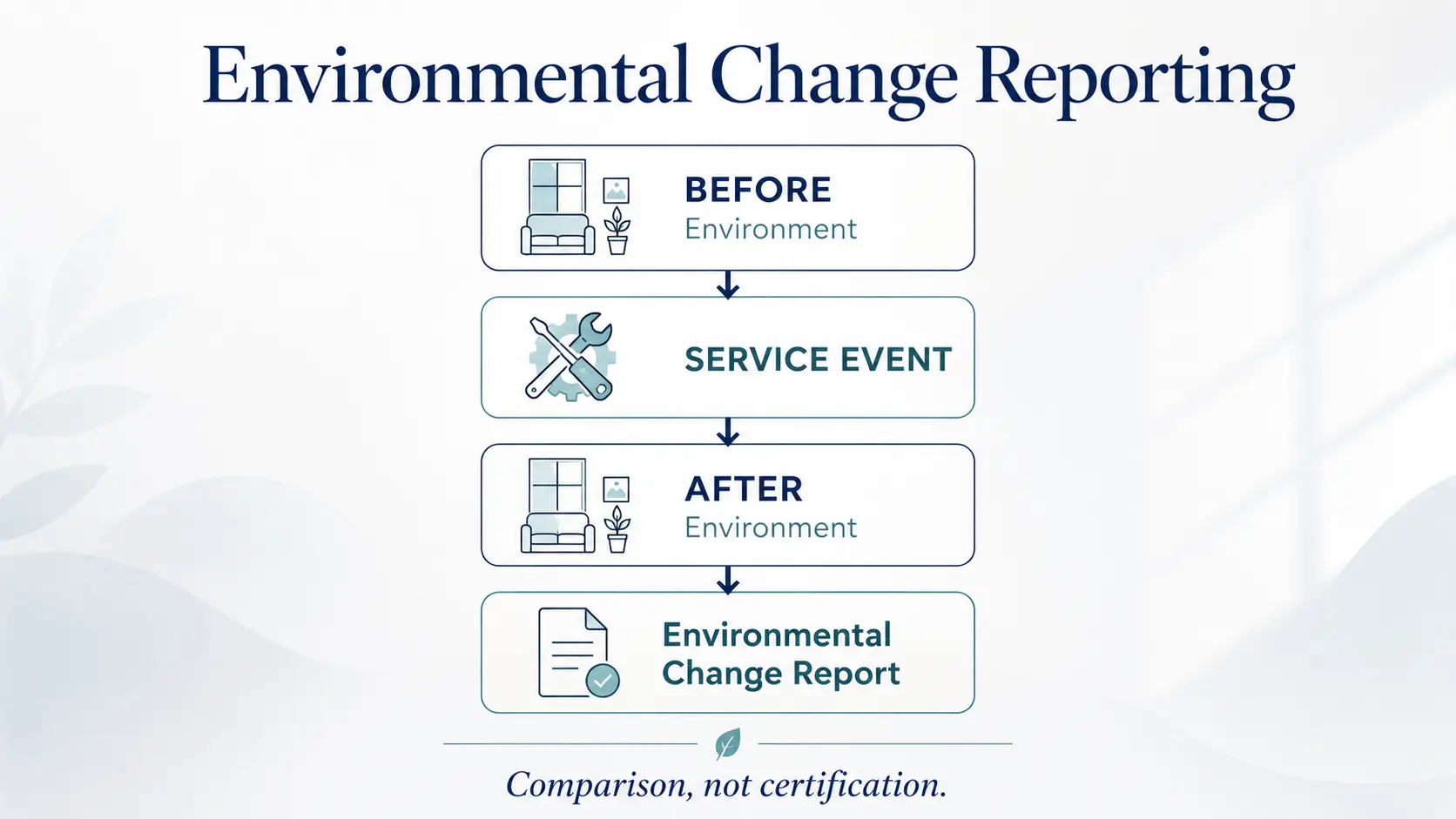
Environmental Change Reporting is a structured method for collecting, comparing, and communicating environmental observations taken around a defined event.
That event could be an HVAC or air-duct service, a cleaning or remediation job, a ventilation adjustment, a filter change, a shift in building occupancy, or any activity that could reasonably affect measured conditions.
The report establishes a documented observation period before the event, another after it, and the context needed to make the comparison mean something. What it produces is not a certificate declaring an environment "safe" or "healthy." It's a record of what the instruments actually observed, under conditions you can see and check.
That distinction is the whole point, and I'd rather explain it plainly now than have a customer discover the difference the hard way later.
Why “Change,” Not “Score”
Environmental data usually shows up as an isolated number. A particulate reading. A CO2 concentration. A humidity percentage. Numbers look precise, and precision gets mistaken for meaning more often than it should.
To actually interpret a reading, you need to know what was measured, where the sensor sat, when it was recorded, what was happening nearby, and what the instrument is even capable of detecting in the first place. EPA guidance is direct about this: consumer air monitors only detect the pollutants they were built to measure, and a particulate sensor has nothing to say about radon or carbon monoxide. EPA is equally direct that a single monitor can't stand in for a complete indoor air quality picture.
Environmental Change Reporting doesn't try to paper over that limitation. It asks a narrower question instead, one the evidence can actually support:
Under documented conditions, did the selected measurements differ between the observation periods?
That's a smaller claim than "your air is now clean." It's also one you can defend.
Observation Is Not Causation
Say fine-particle readings come in lower after a service call. The report can say that. What it can't say, on its own, is that the service caused the drop.
Plenty of other things could explain it: the HVAC cycled on or off, a window opened, someone cooked or cleaned, occupancy changed, outdoor conditions shifted, the sensor moved, humidity affected the reading, or the two observation windows simply weren't comparable to begin with.
I built my career around separating four things that get blurred together constantly:
- Observation — what did the instrument actually record?
- Comparison — how did one period differ from another?
- Interpretation — what might reasonably explain that difference?
- Conclusion — what does the evidence actually support, and where does it stop?
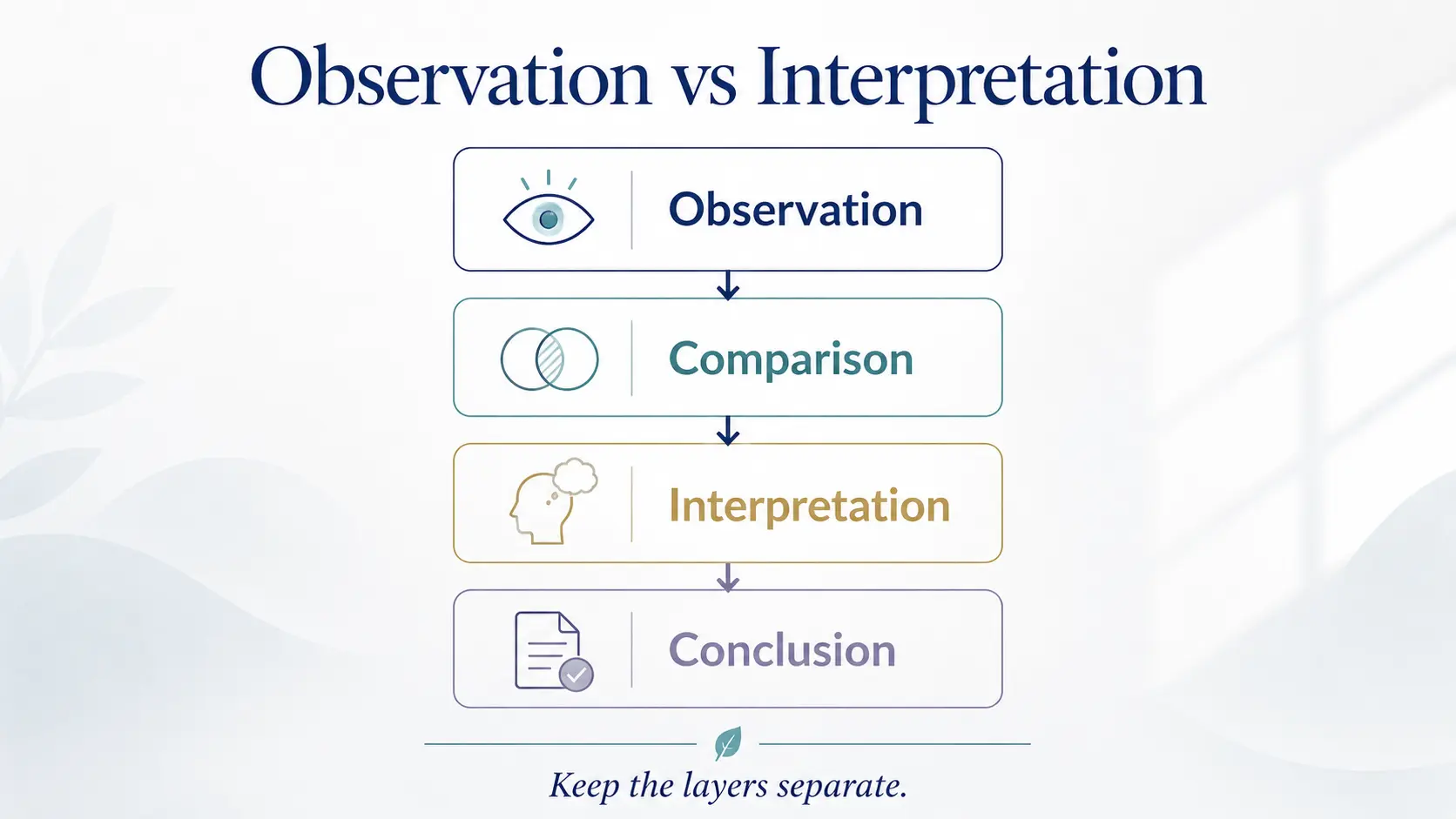
Environmental Change Reporting exists to keep those four layers visible instead of letting them collapse into each other, because that collapse is exactly where overclaiming starts.
Why Context Belongs in the Report
EPA's guidance recommends documenting sensor placement, nearby doors and windows, room use, and any temporary activity that could influence a reading, because cleaning, cooking, and construction can all confuse the data if nobody wrote them down.
A useful environmental report includes more than a chart. It documents:
- Device identification and sensor placement
- Observation start and stop times
- HVAC operating state and approximate occupancy
- Open windows or doors, and known activity nearby
- Interruptions, movement, or loss of power
- Anything meaningfully different between the two observation periods
Skip that context and the chart might still look good on a screen. It just won't tell you much.
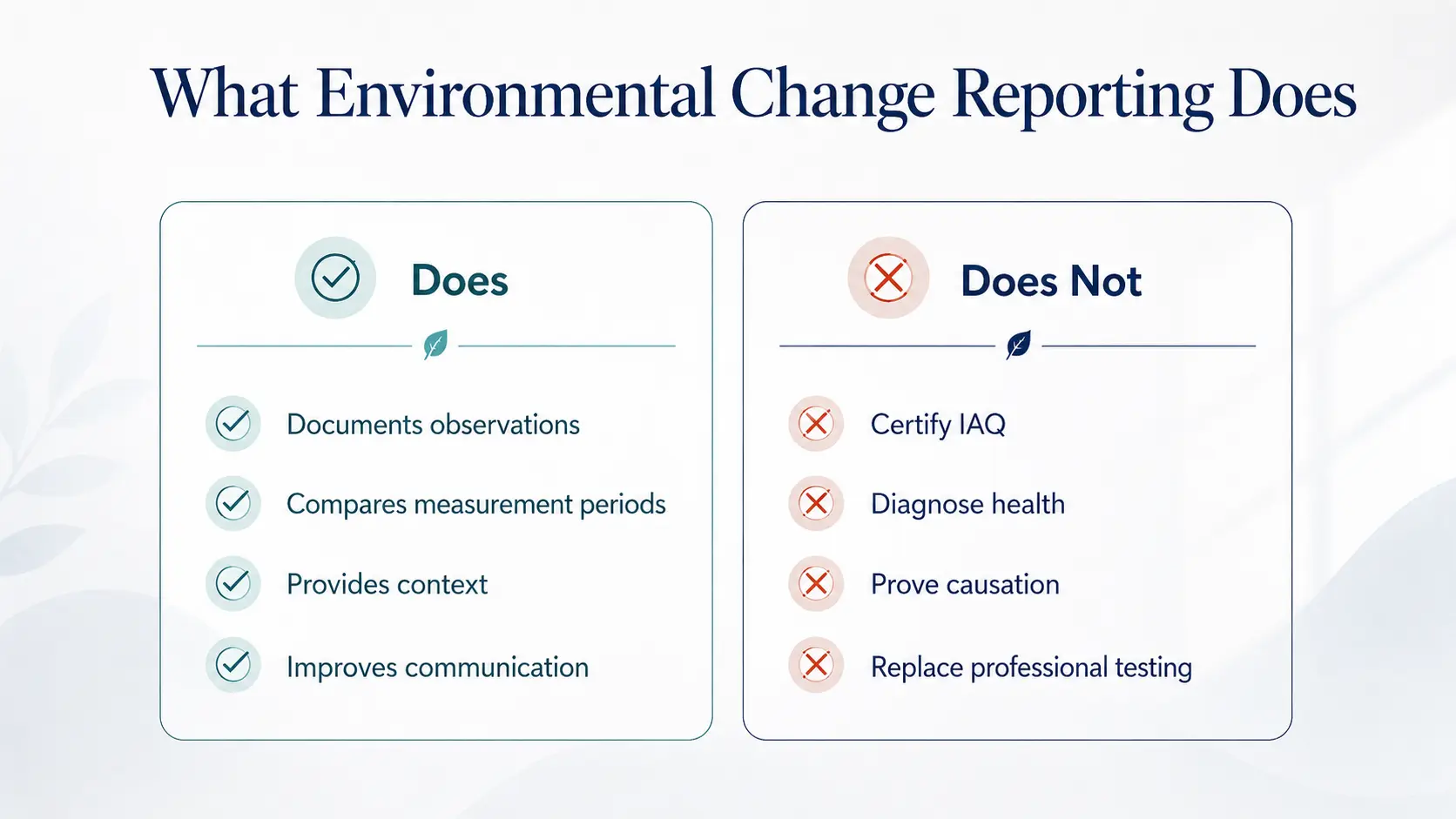
What an Environmental Change Report Can Say
- Fine-particle measurements were lower during the post-service observation period.
- CO2 values stayed in a similar range before and after.
- Relative humidity increased during the second observation period.
- A short spike occurred while occupants were cleaning the room.
- The available observations don't establish why the change happened.
- The two periods weren't comparable enough to support a reliable before-and-after read.
None of those statements oversell what the data can do. That's deliberate.
What It Cannot Say
An Environmental Change Report doesn't certify indoor air quality, diagnose a health condition, detect or certify mold, establish regulatory compliance, prove a service worked or failed, or replace a licensed inspection or lab analysis.
EPA draws that same line, distinguishing low-cost consumer monitors from certified emergency devices and regulatory-grade monitoring. Consumer sensors can be genuinely useful. They don't get to claim more authority than they've earned.
Where Veris Fits
CLARVON is developing Veris to support consistent environmental observation around professional service work, helping technicians collect, organize, and communicate before-and-after data through a repeatable process.
Veris isn't meant to replace a technician's judgment or stand in for professional testing. It won't turn a short observation window into proof of causation, and I'm not interested in building a product that pretends otherwise.
What it's meant to deliver is more practical than that: better documentation, more transparent customer communication, a structured comparison, and a clear line between what was measured and what that measurement means.
A More Honest Kind of Confidence
I don't think customers need certainty manufactured for them. I think they need to know what was actually observed, what changed, what stayed the same, what might have influenced the result, and what the evidence doesn't establish.
That's what Environmental Change Reporting is for. Not certainty. Not certification. Just a more honest accounting of the evidence that actually exists, documented the way I'd want it documented if it were my own house.