
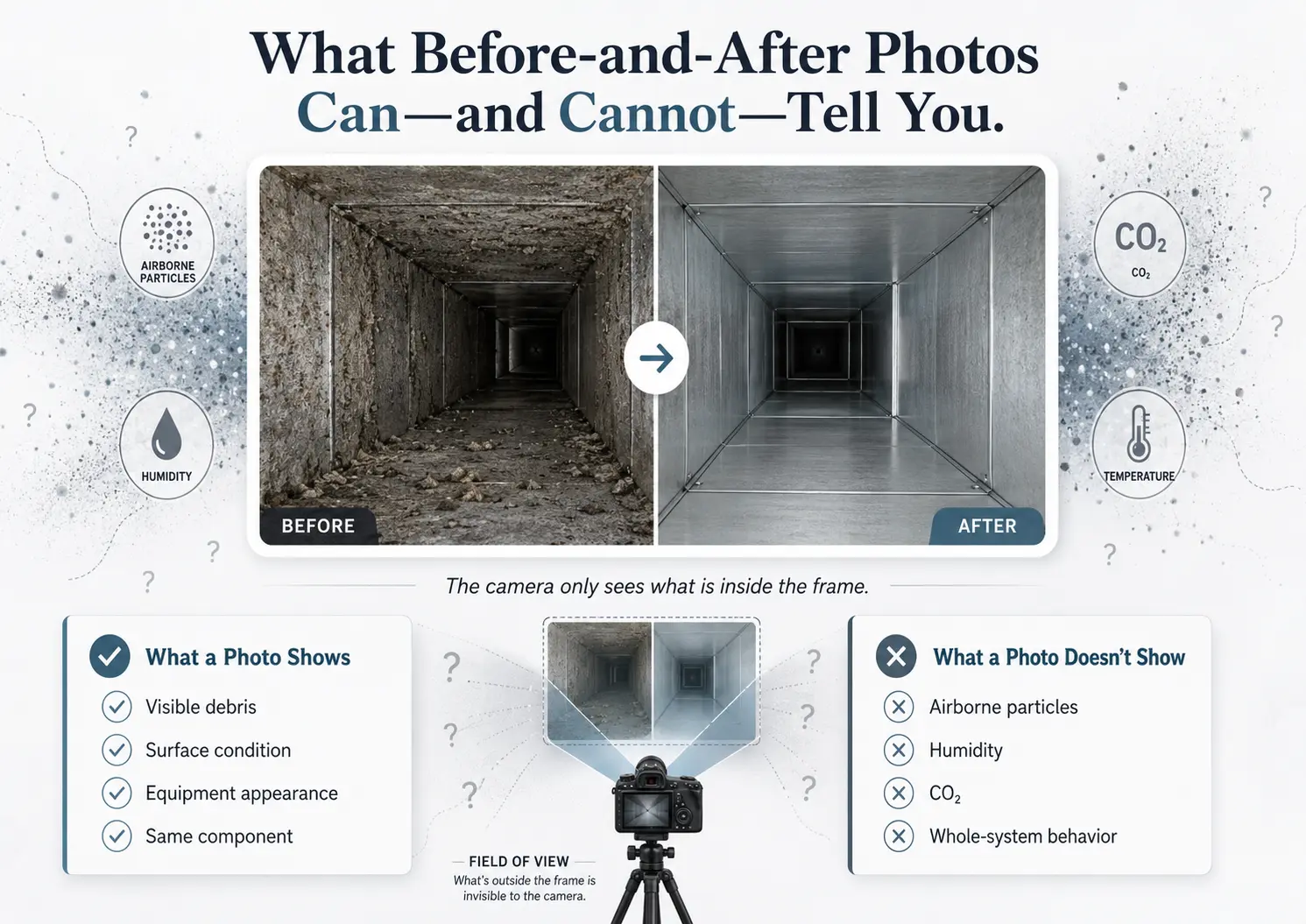
Before-and-after photos are one of the most useful tools in professional service documentation. They're immediate, they're easy to understand, and they let a customer see areas they couldn't safely or conveniently inspect themselves.
They also have limits. I've reviewed a lot of imagery in my career where the picture was accurate and the conclusion drawn from it wasn't. The problem was never the photo. It was the story someone decided the photo was telling.
What a Good Photograph Can Document
A well-captured service photo can show visible dust or debris, staining or corrosion, a blocked or restricted component, the condition of an accessible duct, register, coil, blower, drain pan, or filter, and whether a component looks cleaner after the work or was reassembled correctly.
EPA recognizes visual inspection as an appropriate way to confirm heating and cooling components appear clean after duct cleaning, and notes some providers use remote photography to document internal duct conditions. That's a legitimate, valuable use of the tool. A photo shows what was in its field of view, at the moment it was taken. That's genuinely useful. It's also all it does.
What a Photograph Cannot See
A photo normally can't quantify fine particles suspended in room air, CO2 concentration, relative humidity, temperature trends, invisible gases, airflow rates, or conditions anywhere outside the frame, before or after the shutter clicked.
A photo of clean sheet metal is evidence about that sheet metal. It's not a measurement of the room's air. EPA describes environmental monitors as instruments built to detect specific factors like particulates, CO2, temperature, and humidity, and is clear that even those monitors can't provide a complete picture of indoor air quality, because they only measure what they were built to measure. If a sensor with actual measurement capability can't claim to see everything, a camera doesn't get promoted to that job just because the lighting was good.
The Field-of-View Problem
Every photo has a boundary. Something's inside the frame, everything else isn't, and that raises real questions: was the photographed area representative? Were the before and after shots taken at the same spot, angle, and lighting? Was the same portion of the component shown? Were the less favorable areas left out of frame?
None of that makes photography untrustworthy. It's exactly why documentation discipline matters.
Better Standards for Service Photography
A stronger before-and-after process should record the date and time, component or location, camera orientation, before-or-after status, the technician's identity, whether the shot is representative or exception-based, and confirmation that paired images actually show the same area. Wherever practical, keep the camera position, distance, lighting, and field of view consistent between the before and after shots.
The goal isn't a nicer-looking photo set. It's evidentiary consistency, the kind that holds up if a customer or a regulator ever asks a follow-up question.
Appearance and Airborne Conditions Are Different Questions
Say a technician photographs a return duct before cleaning, with visible debris. After cleaning, a second photo shows a lot less visible material.
The supportable conclusion: the photographed surface appears to contain less visible debris after cleaning. That's clear and defensible.
What isn't supported by that photo alone: that airborne particle levels decreased, that occupant exposure dropped, that health improved, that all the ductwork is equally clean, or that the service resolved whatever concern brought the customer in the first place. EPA warns against unsupported health-benefit claims for duct cleaning specifically, and recommends assessing the complete system rather than one isolated component.
Photographs and Measurements Work Better Together
A photo answers what an accessible surface looked like, whether visible material was removed, and whether equipment was reassembled correctly. Environmental measurements answer what the supported sensor values showed during the observation period, whether those values differed before and after, and whether temperature, humidity, or particulate patterns shifted.
Neither one is complete on its own. Together, they build a record worth trusting.
The Role of Narrative
Customers also need a plain-language summary that doesn't overreach. Something closer to: photos show visible debris was removed from the documented duct sections; separate environmental observations recorded lower fine-particle measurements during the post-service window; these findings describe the documented areas and periods only, and don't establish health outcomes or prove the service was the sole cause of the measured change.
That's a less dramatic sentence than "your air is now clean." It's also one I'd actually stand behind.
Use the Evidence You Have
Documentation isn't there to manufacture certainty. It's there to preserve evidence. Use photos for visible conditions, instruments for supported measurements, notes for context, and professional judgment to explain what the combined evidence reasonably suggests. Then stop where the evidence stops.
That last part is usually where a company either earns trust or loses it.