
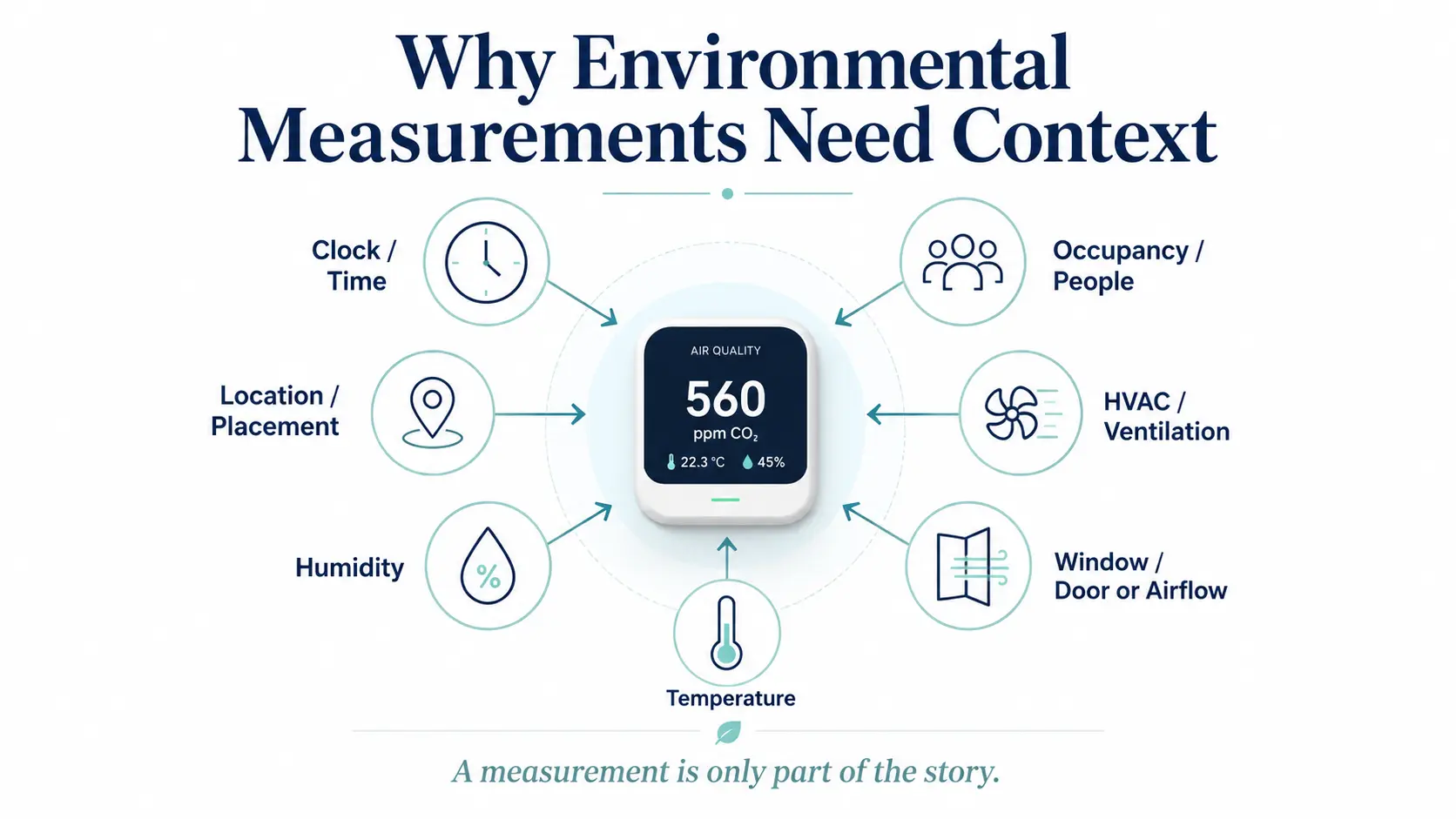
A sensor produces a number, and a number feels objective. That's part of the appeal, and part of the trap. A number without context can be technically correct and still practically misleading.
Take a CO2 reading of 1,100 parts per million. Is that high? The honest answer is: compared with what, measured where, under what conditions, and for what purpose? Was the room holding one person or twenty? Had the door just closed? Was the HVAC running? Was the sensor sitting next to someone's desk? Was it calibrated? Was the reading a brief peak or a sustained pattern?
Without that information, the number is mostly standing there looking more authoritative than it's earned the right to be. I spent years building assessments where a single data point, however accurate, meant nothing until it was placed against the pattern around it. Environmental readings work the same way.
Measurement Begins With a Question
EPA's sensor-siting guidance starts with a basic question: what do you actually want to learn from the sensor? That question drives where it gets placed, what it measures, how long it runs, and what else needs to be recorded alongside it.
A project built to catch cooking-related particle spikes isn't the same project as one built to compare rooms, evaluate ventilation, or document conditions around an HVAC service. The monitoring objective comes first. The instrument comes second, and a lot of bad data starts with getting that order backward.
Placement Changes Meaning
Sensor location can materially change a reading. EPA advises placing indoor monitors where airflow isn't restricted, and away from pollutant sources, vents, open windows, and drafts, unless the project is specifically designed to observe those features.
A particle sensor next to a stove will accurately catch a cooking plume. That doesn't mean it represents the whole house. A CO2 sensor right next to an occupant may read differently than one placed at a more representative spot in the room. A humidity sensor against an exterior wall may pick up a localized condition. None of that is a sensor malfunctioning. It's a sampling decision, and sampling decisions are exactly the kind of thing that need to be documented, not assumed away.
Time Changes Meaning
Conditions vary. A one-minute observation can catch a door opening, cooking, vacuuming, a group entering the room, or an HVAC cycle starting, and none of that tells you whether the condition persisted, recovered, repeated, or was just a one-off spike.
EPA recommends matching the averaging period to the actual monitoring question. Studying short events calls for minute-level data. A different question is better served by hourly or longer summaries. The right duration depends entirely on what you're trying to learn, not on whatever the default setting happens to be.
Activities Change Meaning
EPA recommends keeping deployment notes because cooking, cleaning, construction, and other temporary activity can affect readings and muddy interpretation. That means tracking occupancy changes, cooking, vacuuming, cleaning products, candles or fireplaces, doors and windows opening, filter changes, HVAC mode and runtime, and any service activity nearby.
Skip those notes and it becomes easy to mistake an ordinary Tuesday for a building-wide condition, or a service-related result that never actually happened.
Temperature and Humidity Can Influence the Sensor Itself
Environmental conditions can affect both the air being measured and the device doing the measuring. EPA identifies temperature and high humidity as factors that can push some air sensors toward inaccurate readings, and recommends evaluating sensor performance across the temperature, humidity, and concentration ranges expected for the actual application.
That doesn't make the measurements useless. It means understanding the limits of the instrument, and not treating every digit on the screen as unquestionable.
Carbon Dioxide Is a Useful Example
Indoor CO2 gets used as a ventilation indicator constantly, and it can be useful when read correctly. ASHRAE is explicit that CO2 readings need to be understood in context: occupancy, length of occupancy, activity level, ventilation design, other CO2 sources, sensor accuracy, location, and calibration. ASHRAE also states plainly that CO2 is not an overall indicator of indoor air quality on its own.
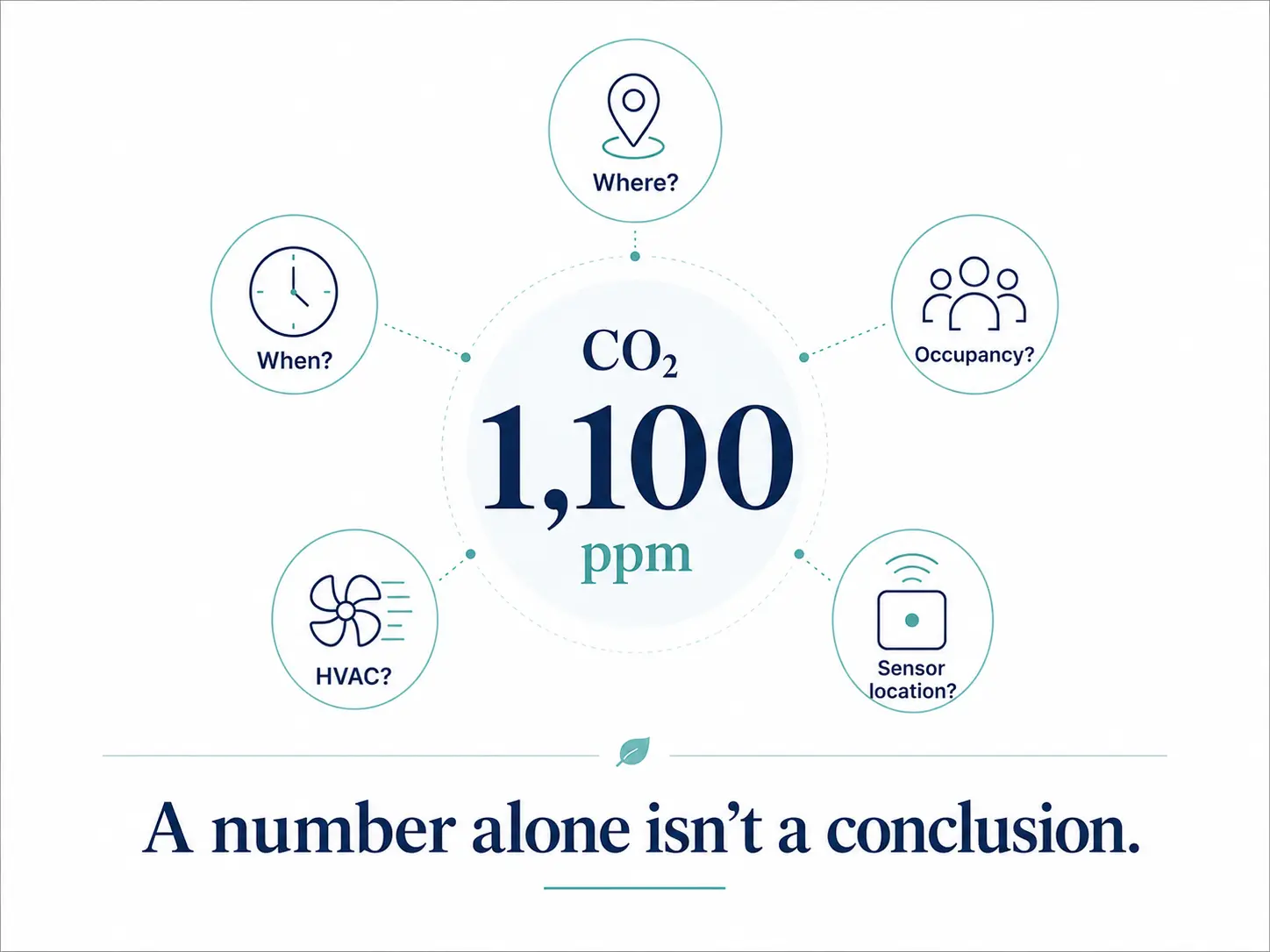
A reading below a popular threshold doesn't certify that everything else in the space is fine. A reading above it doesn't tell you why. The context is what determines what the number can actually contribute to the assessment.
The Difference Between Variability and Change
Say a pre-service particle average is 8 units and the post-service average is 7. Is that meaningful? Possibly. But before calling it that, you'd want to know the normal variability of the sensor, the measurement uncertainty, whether the two periods were actually comparable, whether the instrument moved, and whether the difference held up or was a blip.
NIST is clear that measurement uncertainty has to be understood before you can say whether a result is fit for its intended purpose. A mathematically different number isn't automatically an operationally meaningful one, and treating every fluctuation as a finding is how good data ends up telling a bad story.
A Practical Context Record
For structured before-and-after observations, CLARVON recommends capturing, at minimum:
- Device context — device ID, sensor types, firmware, calibration status, any power or connectivity interruptions
- Location context — room or zone, placement height, distance from vents/doors/windows, whether the sensor moved
- Operational context — HVAC mode, fan state, filter condition, open doors and windows
- Human context — approximate occupancy and any major shifts, cooking or cleaning activity, unusual events
- Time context — observation start and stop, service-event timing, comparison duration, data completeness
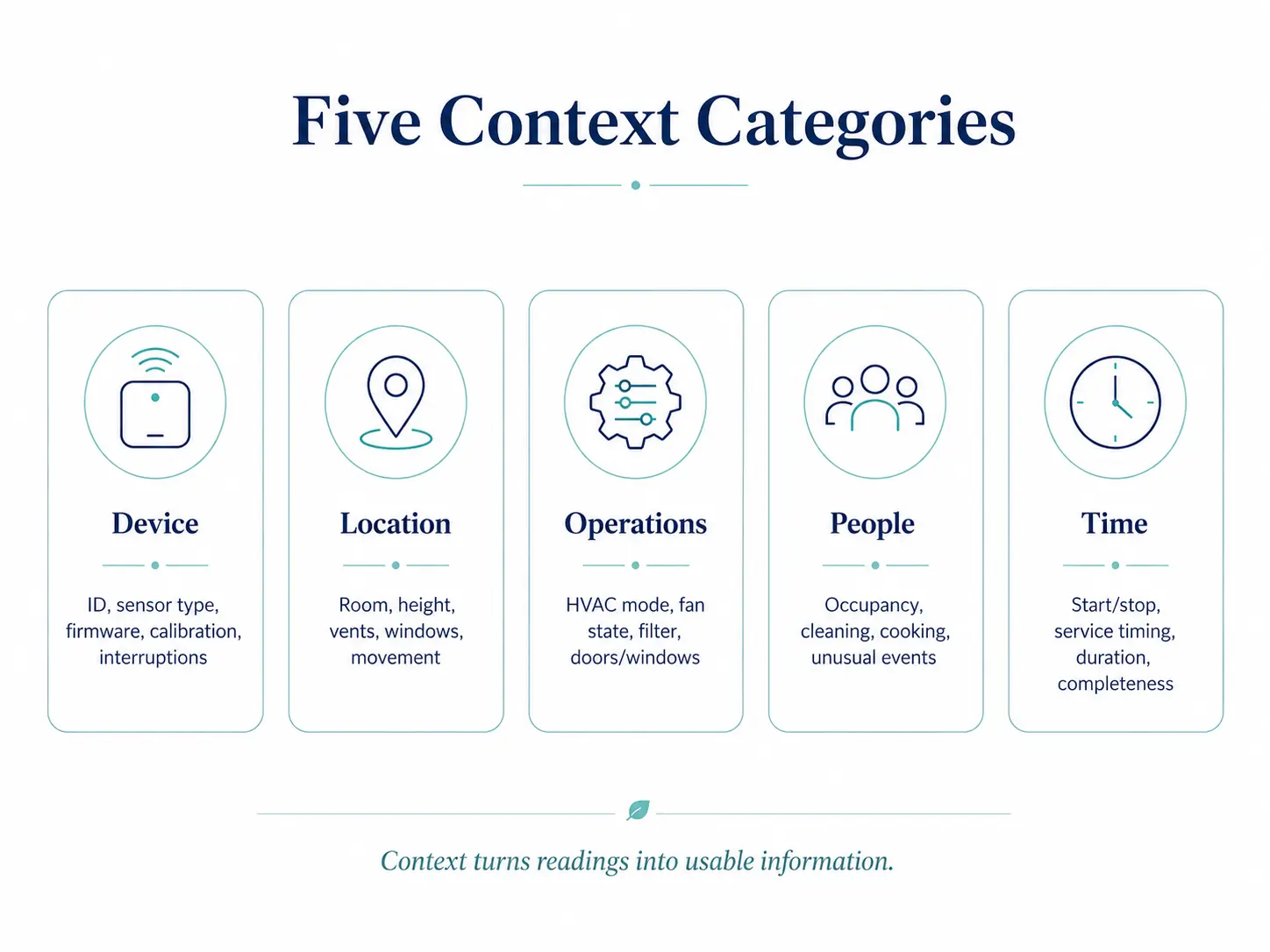
Not every factor matters in every deployment. The record should capture whatever's most likely to change how the comparison gets read.
Context Doesn't Eliminate Uncertainty
Perfect documentation isn't possible, and that's not the goal. The goal is to avoid treating an unexplained fluctuation as if it obviously has a cause. Environmental confidence comes from combining the right instruments with a defined question, consistent procedure, documented context, careful comparison, and visible limitations.
The number is where the explanation starts. It's not the whole explanation, and I'd rather build a product that says so than one that lets the number do more talking than it's earned.