
A device displays a number. A report puts that number on a graph. The graph has a green band running through it.
At that point it becomes very easy for a reader to assume somebody has issued a formal judgment. Safe. Healthy. Approved. Passed. Certified.
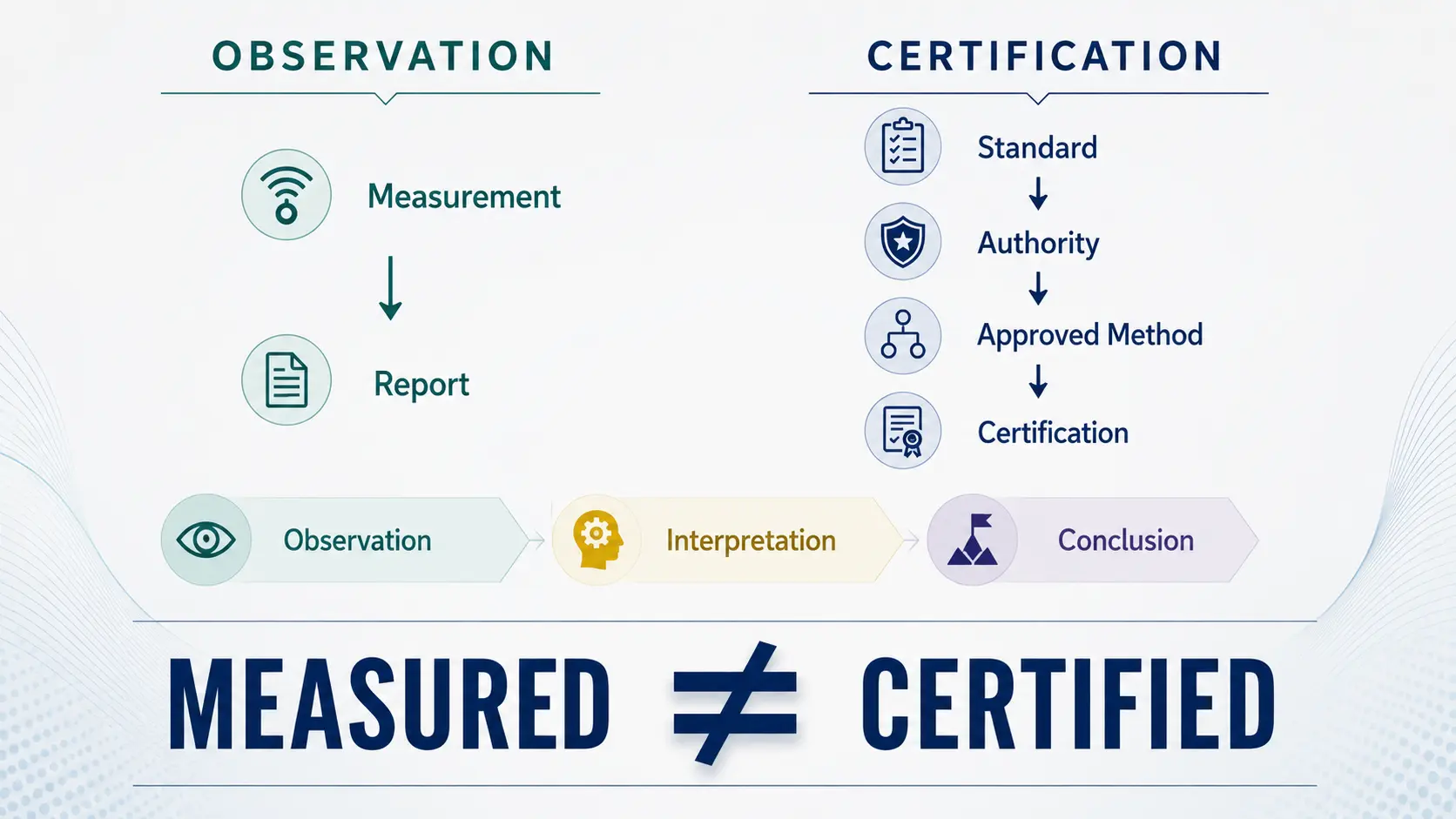
A measurement isn't automatically any of those things. It's an observation, produced by a specific instrument, under specific conditions, for a specific purpose. Certification is a different category entirely, with its own requirements, and I don't want CLARVON's name anywhere near the confusion between the two.
What Is an Observation?
An environmental observation describes what an instrument, inspection, or documented process actually detected: fine-particle measurements rose during cooking, CO2 rose while the room was occupied, humidity stayed higher through the second observation period, a photographed duct surface showed less visible debris after cleaning, the sensor missed data during a power interruption, the post-service average came in lower than baseline.
These stay close to the evidence. They report what happened without dressing it up as proof of something bigger.
What Is Certification?
Certification generally requires a defined framework: an established standard, an authorized certifying body, approved methods and equipment, known performance requirements, specified sampling procedures, quality-assurance controls, defined acceptance criteria, qualified personnel, and a clearly stated scope.
A green screen isn't a certification program. A well-designed PDF isn't a regulatory authority. No instrument acquires legal standing because the typography looks confident, and I'd rather say that plainly than let a customer assume otherwise.
Consumer Sensors and Regulatory Monitors Are Not the Same Thing
EPA explains that informational air sensors can be genuinely useful for understanding general conditions, while also being capable of questionable readings, systematic bias, and results affected by temperature, humidity, calibration, aging, and data interruptions. Separately, EPA evaluates Federal Reference Method and Federal Equivalent Method monitors for regulatory purposes, and those aren't equivalent to ordinary consumer sensors. EPA's voluntary performance targets for informational sensors don't constitute agency certification or endorsement.
That distinction should be visible any time environmental data reaches a customer, not buried in fine print.
One Monitor Does Not Represent the Entire Indoor Environment
A monitor only detects what its sensors are built for. EPA notes a particulate monitor wouldn't necessarily catch radon or carbon monoxide, and that low-cost monitors can't provide a complete picture of indoor air quality on their own, and detected pollutant levels don't independently establish individual health effects.
The rule that follows is straightforward: a report should never make a whole-environment claim from a partial-environment observation. If the device measures fine particles, temperature, humidity, and CO2, the report discusses those factors. It doesn't quietly expand that list to radon, carbon monoxide, mold, biological agents, asbestos, lead, combustion safety, or overall health risk.
Why “Mold Detected” Is a Particularly Dangerous Claim
General environmental sensors don't identify mold. Even dedicated mold sampling requires careful interpretation. CDC/NIOSH states there are no health-based indoor-air standards for mold or other biological agents, doesn't recommend routine mold air sampling in building evaluations, and notes that short-term mold samples may not represent actual exposure and can't be interpreted directly against health risk.
A humidity increase may mean conditions got more humid. It doesn't identify mold. A particle increase may mean the instrument detected more airborne particles within its own measurement range. It doesn't identify what those particles were. This is a boundary CLARVON reports need to hold without exception.
Colors Need Limits Too
Color helps people interpret data fast. It can also manufacture certainty that isn't earned. A green indicator can get read as "safe" or "no action required." A red indicator can get read as "dangerous" or "evacuate now." Those readings may not be justified at all.
EPA notes that widely accepted indoor concentration limits don't exist for many pollutants, and that alert thresholds on consumer monitors are often set by the manufacturer, not a regulatory body. EPA also distinguishes informational monitor alerts from certified smoke and carbon-monoxide alarms built to warn of immediate danger. Anywhere CLARVON uses color bands, the interface and report should say what the category represents, what comparison method was used, that it's informational, what it doesn't establish, and whether further professional evaluation might be warranted.
Observation, Interpretation, and Conclusion
A disciplined report separates three layers. Observation: fine-particle measurements were higher during the service period than the baseline. Interpretation: service activity, movement, equipment operation, or another temporary source may have contributed. Conclusion: the data documents a temporary measured increase but doesn't establish its precise source or a health implication.
That structure is what keeps an observation from quietly turning into a diagnosis, which is the single most important habit this whole company needs to protect.
What Veris Is Intended to Do
Veris is built to support structured observations, consistent before-and-after comparisons, technician documentation, customer communication, context capture, transparent limitations, and durable Environmental Change Reports.
It's not built to certify indoor air quality, and it's not meant to replace regulatory monitors, emergency alarms, lab analysis, licensed inspection, or medical evaluation. Its value is disciplined documentation, which admittedly sounds less exciting than claiming to know everything about a building from a small device on a tripod. It's also the only version of this product I'm willing to put my name on.
Better Language Builds Better Trust
Responsible reporting sounds like: "the sensor observed," "during the documented period," "measurements were higher or lower," "the available data suggests," "this may be consistent with," "the cause was not determined," "additional evaluation may be appropriate."
It avoids: "the building passed," "the air is safe," "the mold is gone," "the service worked," "the environment is healthy," "there is no risk." Customers don't need manufactured certainty. They need information they can actually understand and act on.
The Standard CLARVON Should Hold
Every CLARVON report should make five things easy to find: what was measured, how and where it was measured, what was observed, what might limit interpretation, and what the report does not certify.
That's not a timid way to write a report. It's a competent one. Observation creates real value when it helps people understand their environment more clearly. Certification only gets claimed when the authority, methods, scope, and evidence actually exist to back it up. Until then, an observation stays an observation, and it's useful enough on its own without borrowing someone else's credibility.